1. Operating emergency system in preparation for heavy snow special weather report
Operating the Disaster and Safety Countermeasures Office
- Period: Nov. 15 - Mar. 15, 2020 (for 4 months) (※ 24-hour operation)
- Location: 33 locations (25 operated by the Seoul Metropolitan Government and district (“-gu”) offices, 6 by Road Management Office and 1 by KoROAD)
- Snow removal target: 8,217 km (1,218 km of Seoul city roads (excluding overlapping sections), 7,025 km of district roads)
- Method of operation: Five-step response

- Emergency duty by stage
- Work standard by stage: Five stages (at ordinary times, reinforcement, level 1, level 2, level 3)
- At ordinary times - Level 1: Preparatory stage, operations supervised by head of Road Management Division
- Levels 2 - 3: Emergency stage, snow removal operation carried out under the system of the Disaster and Safety Countermeasures Office

Snow removal areas
- Seoul Metropolitan Government (Road Management Division): Supervising and overseeing snow removal measures and operations
- Seoul Metropolitan Government (Road Management Office): General roads, Hangang River bridges, motorcar roads (Olympic-daero, Gangbyeonbuk-ro, Dongbu Expressway (Gunjagyo Bridge - Yongbigyo Bridge))
- Seoul Facilities Corporation: Motorcar roads
- Naebu Expressway, Dongbu/Bukbu Expressway, Hangang River bridges (Seongsandaegyo Bridge, Cheongdamdaegyo Bridge), Seobu Expressway, Gukhoe-daero, Yangjae-daero, Eonju-ro, Umyeonsan-ro
- District (“-gu”) offices: General roads, district roads
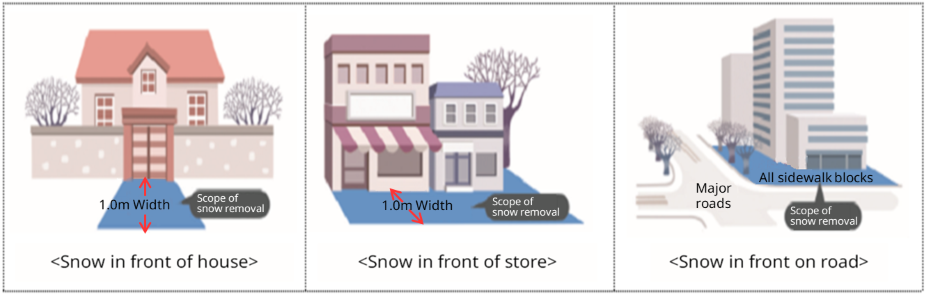
- Residents: Around house and store, snow removal from roof (Ordinance amended on Jul. 14, 2016)
- Building manager to administer snow/ice removal operation on sidewalks, side streets and pedestrian roads around the building and roof of the building
2. Establishing preemptive response system and promoting swift snow removal operation
Strengthening prediction and establishing early-stage response system
- Establishing heavy snow prediction system in preparation for abnormal weather conditions
- Installing CCTVs on heavy snow routes along the West Coast to detect signs of heavy snow approx. one hour in advance and start early-stage snow removal operation
- Installation locations (5): Incheon, Munsan, Ganghwa, Ongjin, Hwaseong
- Video information provided real-time to 33 subsidiary (city and district) agencies implementing snow removal measures
- Managing snow removal operation real-time using snow removal site management system
- Installing mobile devices on snow removal vehicles (GPS + keypad) (307 units)
- Checking traffic conditions on major roads real-time (CCTV)
- Checking snow removal status real-time by receiving data from CCTV (786) of Seoul Metropolitan Police Agency
- Checking amount of snowfall and traffic conditions in frequently controlled routes on a real-time basis
- Video system management for Bugaksan-ro (Jongno-gu, Seongbuk-gu), Inwangsan-ro (Jongno-gu) and Samcheongdong-gil (Seongbuk-gu)
- Promoting communication with the field and citizens through social media (Twitter and other social media, Seoul Smart Report)
- Community mapping for citizens’ complaints (Seoul Smart Report - Areas without snow removal, areas of frequent ice formation)
- Twitter (@seoulmania, @seoulroadmania, #SeoulSnowRemoval), Facebook (seoul.go.kr)
- TBS correspondents, volunteer firefighters, disaster information correspondents
Judging the situation and issuing emergency alert at the right time
- Swiftly responding to situation based on judgment
- Issuing watch for preemptive response considering weather forecast and vulnerable period, etc.
- Issuing emergency alert three hours before heavy snow forecast, allocating snow removal equipment and personnel one hour before heavy snow
- Ensuring effective snow removal operation by establishing “real-time snow removal site management system”
- Real-time snow removal operation by installing mobile devices (GPS + keypad) (307 units) on snow removal vehicles
- Instantaneously responding to field situations through close command system centering on the control tower
Establishing response system for heavy snowtorm
- Securing the fields of elementary, middle and high schools as the sites for remaining snow handling (68 locations)
- In the case the capacity of previously secured remaining snow handling sites is exceeded as a result of heavy snow by 10 cm or more in depth, one - two school fields are additionally used per district (“-gu”) area
- The school fields are used as temporary remaining snow piling yards and then restored afterwards
- Utilizing equipment from construction sites, privately owned equipment and equipment/personnel from military units and the police
- Establishing private construction equipment support system
- In case of heavy snow, each district (“-gu”) office supports equipment necessary in snow removal
Expanding eco-friendly snow removal method
- Amount of deicing agents secured in 2019/2020: Calcium chloride 40%, salt 40%, environmentally certified material 20%
- Promoting continuous increase in the rate of environmentally certified deicing agent use in line with the demand for eco-friendly snow removal operation
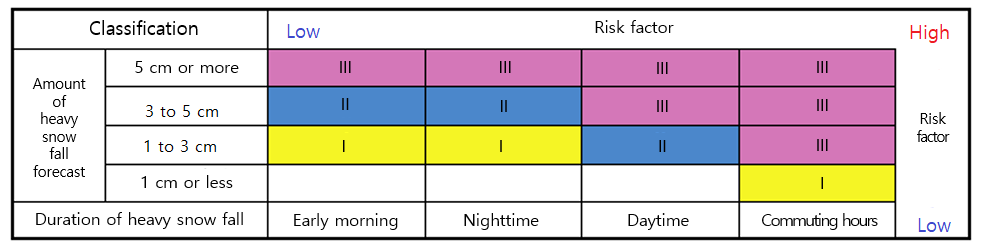
- Preparing criteria for deicing agent spray in advance
- Setting pre-spray sections and methods by stage considering amount of snowfall and time
- Criteria for deicing agent spray in advance
- Operating automatic liquid spray devices for early-stage snow removal in vulnerable areas
- 79 liquid spray devices and 27 heating wires installed and operated in 2019
- Increasing installation of automatic liquid spray devices for side streets
- Effect: Effectively reducing snow removal time through early response to sudden heavy snow
- Operation plan: 477 devices in 23 districts (“-gu”)
- Increasing the use of wet cleaning vehicles by districts (“-gu”) offices and KoROAD
- Increasing operating rate of vehicles that are suspended of operation in winter season and improving early response capacity by using eco-friendly liquid deicing agent
- Vehicles: 64 vehicles secured (51 wet cleaning vehicles, 13 general vehicles)
- Operating small-scale snow removal devices suitable for sidewalks and side streets
- 68 small-scale snow removal devices, 419 fans and 235 small-scale spray devices, etc.
3. Activating disaster prevention governance through citizens’ participation
Snow removal with volunteers and partners of the Seoul Metropolitan Government
- Promoting snow removal operation by designating areas in charge (by neighborhood (“-dong”)
- Promoting snow removal activities through cooperation with Citizen Corps Active in Disaster as well as volunteer firefighters, etc.
- Encouraging establishment of culture to enjoy snow and snow removal
- Publicizing the “Shovel Your House and Store” campaign

- P.R. through various channels, such as broadcasting, websites, publications, social media and signboards
- Snow removal/shoveling photo contest
- Description: Photos of snow removal on public roads or squares within three days of snowfall
- Period: Nov. 15, 2019 - Mar. 15, 2020
- How to enter:
- Seoul Smart Report (app): Check the “Safety Report” section and upload photo
- KakaoTalk: Create ID (snowseoul), enter name and telephone number and upload photo
- Offline: Submit photo to Road Division (Engineering Work Division) or local community center
- Encouraging citizens’ voluntary participation in snow removal through various P.R. activities
- Publicizing citizens’ duty of snow removal according to the Ordinance on Snow and Ice Removal by Building Managers
- Broadcasting, SNS, websites of the Seoul Metropolitan Government and districts (“-gu”) offices
4. Managing vulnerable points and establishing pedestrians’ safety measures
Maintaining and managing vulnerable points
- Vulnerable Points: 289 locations
- 36 lamp post on the Hangang River, 38 intersections, 87 underpasses, 34 overpasses and 94 uphill roads
- Designating persons in charge of each route passing through vulnerable points
- Organizing and operating teams in charge of snow removal at vulnerable points
- Team: At least one team by organization responsible for snow removal (four persons + at least one vehicle)
- Operating small-scale snow removal devices suitable for sidewalks and side streets
- 68 small-scale snow removal devices, 419 fans and 235 small-scale spray devices, etc.
Establishing safety measures for pedestrians, such as to prevent falling accident
- Installing and managing free snow removal tool boxes for residents’ voluntary participation
- Operating snow removal teams with citizens’ participation
- Target: Basic livelihood security recipients, second-lowest income class, university students, the unemployed
- Duties: Removing snow in the designated areas in case of heavy snow, removing ice in areas where the road is frozen, checking snow removal materials and tools in snow removal tool boxes located in the designated areas
Establishing general transportation measures
- Establishing measures to extend subway train and bus operations during peak hours and delay time for last train or bus service
- Peak time: A time of day when the rate of road occupancy by vehicles is the highest
- Establishing measures to extend bus operations during peak hours and delay time for last bus service
- Managing detour of buses according to road control, such as due to snowfall or ice on the road
- Frequently controlled sections: 2,006 buses on 84 routes of 11 roads
- Providing real-time information on bus detour through BIT, SNS and TOPIC websites
- Minimizing citizens’ inconvenience by arranging inter-city bus detour real-time using BMS
- Establishing management plans for subway-related vulnerable areas
- Facilities vulnerable to snowfall: Ground-level stations, stations where canopies are not installed and train depots (29 ground stations, 177 stations without canopies, 31.8 km of ground tracks)
- Securing sufficient winter supplies, operating PSD system in case of heavy snow and snow removal in station (Seoul Metro), starting snow melting devices in and
- sending snow removal team to train depots and ground tracks in case of snow
- Establishing measures for safe operation of late-night buses in preparation for unexpected situations, such as snowfall at night
- Target: 70 buses on nine routes
- Strengthening vehicle maintenance system before operation, providing guidelines and training in preparation for unexpected situations, establishing a system for emergency input of substitute vehicles in case normal bus operation is impossible due to disaster or accident
- Monitoring traffic conditions and providing traffic information on a real-time basis