1. Establishing measures for public medical service at all times
Establishing and implementing public health emergency medical service system
- Emergency medical institutions: 48 in total (31 regional/local emergency medical centers, 17 local emergency medical institutions)
- Operating system
- Seoul Emergency Operations Center (119): Emergency rescue, patient evacuation to hospital
- Emergency Situation Management Center (119): Consulting for emergency patients, guiding treatment, providing information on hospitals
- Emergency medical institutions: Treating emergency patients
2. Strengthening infectious disease prevention and control activities
Operating infectious disease monitoring and swift response team
- Period: Nov. 15, 2019 - Mar. 15, 2020
- Epidemiological Investigation and Disease Control Team: 26 teams (1 in the Seoul Metropolitan Government, 25 in public health centers) with 231 members
- Details of work
- Monitoring and daily report on the occurrence of group patients, epidemiological investigation when infection case occurs
- Operating epidemiological investigation and disease control teams and maintaining emergency duty system
- Promoting anti-epidemic sterilization and infectious disease prevention measures by season
- Maintaining emergency contact network in preparation for emergency situations
- 24-hour emergency contact network with the Seoul Metropolitan Government (district ("-gu") offices), Research Institute of Public Health and Environment, National Quarantine Station, and Korea Centers for Disease Control & Prevention
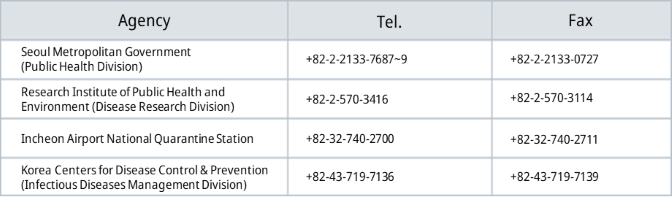
Operating medical institutes for isolation treatment in preparation for the outbreak of new infectious disease
- Hospitals with the state-designated isolation units: National Medical Center, Seoul National University Hospital, Seoul Medical Center, Chung-ang University Hospital, Hanil General Hospital
- Reference hospitals in Seoul: Soonchunhyang University Hospital, Samyook Medical Center, Korea University Guro Hospital, Inje University Seoul Paik Hospital, Inje University Sanggye Paik Hospital
Strengthening follow-up survey on people entering country from contaminated areas abroad
- Targeting six countries from which airline service to Incheon International Airport is available among 59 contaminated regions (as of Jan. 1, 2018)
- Monitoring display of symptoms over the phone during the maximum incubation period by suspected disease
Criteria for determining infectious disease by stage and handling actions

3. Safety management of drinking water, such as in mineral spring
Safety management of drinking water, such as in mineral spring
- Drinking Water Facilities: 209 in total (203 in district ("-gu") areas and 6 in parks)

- Management details
- Regular water quality inspection: 3 to 8 times a year according to management class by facility
- If result indicates that the facility does not conform to standard, re-inspection is conducted following cleaning and maintenance ⇒ If result indicates that the facility conforms to standard, the facility is continuously used. However, if the standard for continuous use is exceeded, step-by-step measures are taken, such as to stop the facility use, suspend the facility use and shut down the facility
- Intensive management: Four times or more a year on nonconforming facilities
- Management method: Cleaning facility by removing contaminants in the surroundings, observing depth of spring, improving facility
Safety management of drinking spring water and drinking deep sea water in the market
- Target: Drinking spring water and drinking deep sea water distributed in the market
- Collection and inspection: Regular inspection four times a year and additional inspections as necessary (by the Research Institute of Public Health and Environment)
- Inspection items: 50 items for drinking spring water, 52 items for drinking deep sea water
- Handling based on result: Disposing of products of the same manufacturing date, administrative disposition through notification to the respective city and provincial governments
4. Strengthening health and hygiene management by season
Safety management of food items in winter
- Joint inspection on businesses manufacturing and processing large-consumption food products in preparation for the kimchi-making season
- Inspection period: Nov. 20 - Nov. 23, 2019
- Items: Chili powder, kimchi, salted seafood and spice products manufactured by 164 businesses
- Inspection details: Use of unregistered or unlabeled products, use or sale of expired products, compliance with standard for hygienic handling of food, etc.
- Collecting and inspecting large-consumption food items during the kimchi-making season
- Inspection period: Nov. 20 - Nov. 23, 2019
- Items: 70 items or more including chili powder, dried chili, salted seafood and seasonings
- Inspection on collected items: Residual pesticide, mycotoxin
- Handling based on result: Seizure, disposal and banning of distribution immediately upon the decision of nonconformity
- Safety inspection on marine products, such as fish and shell fish, seaweed and crustacean
- Inspection period: Nov. 5, 2019 - Feb. 28, 2020
- Items: Fish and shellfish, seaweed and crustacean
- Inspection on collected items: Norovirus, Escherichia coli, heavy metals
- Handling based on result: Seizure, disposal and banning of distribution immediately upon the decision of nonconformity
- Hygiene and safety inspection on livestock products at year-end and beginning of year
- Inspection period: Dec. 3 - 14, 2019
- Target: Businesses handling livestock products (medium and large-scale shopping centers, traditional markets)
- Inspection details: False labeling, expiration date, storage method, personal hygiene
- Handling based on result: Administrative disposition, such as suspension of business, in case of violation
- Inspection on businesses manufacturing high-demand products for year-end holiday period and New Year’s Day
- Inspection period: Dec. 3, 2019 - Jan. 2020
- Target: 93 businesses manufacturing cakes and spot-sale food manufacturing businesses
- Food manufacturers: Businesses manufacturing high-demand products for holiday season, such as fish meat products, rice cakes and dumplings
- Food distributors: Large-scale shopping centers and health functional food distributors
- Inspection items
- Use of unregistered or unlabeled products
- Use or sale of expired products
- Compliance with standard for hygienic handling of food, etc.
Strengthening food safety and food poisoning prevention in summer
- Joint inspection on businesses supplying food materials to schools and local children’s centers
- Inspecting hygiene of restaurants that are vulnerable to food poisoning, such as restaurants serving raw fish
- Strengthening prevention management, such as by providing education for and publicizing food poisoning prevention
- 1830 Hand Wash experience-type class (May - Nov. annually)
- Target: 113 elementary schools (first - fourth grade students)
- Description: Institutes specializing in food safety education visiting schools to provide education
- Promoting SMS for food poisoning prediction index (May - Sep. 2017)
- Target: Approx. 3,500 food preparation and cooking personnel for group food service and people in military units
- Description: SMS for food poisoning index from KMA and other information to be spread
- Food Poisoning Prediction Index: Index indicating possibility of food poisoning occurrence according to weather situation based on the data of bacterial and viral food poisoning occurrence in the last five years (2010 – 2014)
Intensive inspection on and control of Legionella
- Inspection Period: Apr. - Sep. 2019
- Target: 17 locations by district ("-gu") area/425 locations in Seoul, over 1,400 cases in total
- Cooling towers of large-scale buildings, general hospitals, hotels and saunas, subway stations, restaurants and performance halls
- Handling based on result: In case of nonconformity, re-inspection following cleaning and disinfection
- Legionella: A virus that accounts for 20% of the causes of bacterial pneumonia Inhabiting mainly the contaminated water in cooling towers, water pipelines and drainage pipelines of large-scale buildings, such as hotels, general hospitals and department stores
Investigating on ticks causing severe fever with thrombocytopenia syndrome (SFTS) and scrub typhus
- Period: Apr. - Nov. 2019
- Investigation points: 19 points for ixodid and five points for trombicula
- Investigation method: Collecting ticks and checking for tick-borne pathogens
Promoting strengthened monitoring and disinfection for mosquitoes in advance (Apr. - Nov.)
- Analyzing the status of mosquitoes mediating diseases, such as Japanese encephalitis, by installing black light traps (collection net)
- Analyzing causes of mosquito generation using digital mosquito monitoring system (DMS) (50 in total) and reflecting result in disease control
- Intensively administering disinfection in vulnerable areas including social welfare centers, public toilets and areas with a large number of the homeless
- Continuously promoting larva rescue operation in habitats (drains, creeks, puddles and reservoirs)
- Encouraging citizens’ participation in mosquito control by operating mosquito forecast system (May - Oct. annually)
- Forecast method: Posting on the Seoul Metropolitan Government website (http://health.seoul.go.kr)
- Details of forecast: Forecast level and citizens’ action plans by level

- Promoting preventative measures for mosquitoes in winter (Nov. 2019 - Apr. 2020 , for 6 months)

5. Blocking infectious disease of domestic animals, such as foot-and-mouth disease and AI
Operating foot-and-mouth disease and AI situation room
- Period: Oct. 1, 2019 - Feb. 28, 2020
- Headquarters: Animal Protection Division, Seoul Metropolitan Government (Director: Head of Citizens’ Health Bureau, Deputy Director: Head of Animal Protection Division)
- Situation Room: 32 in total (seven in Countermeasures Office, 25 in district ("-gu") office)
- Countermeasures Offices (7): Hangang River Management Office, Research Institute of Public Health and Environment, Seoul Grand Park, Children’s Grand Park, Seoul Forest, Dream Forest, Seoul Facilities Corporation Cheonggyecheon Management Office
- Seoul Metropolitan Government and relevant organizations: Maintaining 24-hour emergency contact network
Strengthening disease control activities in poultry, cattle and pig farms
- Designating officers in charge of livestock farmhouses and inspecting disease control status: Once a day or more
- Disinfection for disease control
- Providing support for disease control from public health centers (institutions) to farmhouses (once a week or more), checking the status of self-disinfection (once a day), installing signboards and disinfecting chambers for AI and foot-and-mouth disease quarantine at the entrances to farmhouses, increasing training for livestock raising and breeding facilities
- Increasing Inspection in Major Habitats for Migratory Birds (Gangseo Wetland Ecological Park, Jungnangcheon Stream, Cheonggyecheon Stream): Disinfection and inspection at least once a week